… their eyes were opened and they recognized him. -Lk 24:31
Catholic.Work
A nonprofit apostolate in the service of Christ and Church
A Mission of the Lay Christian Faithful
Catholic.Work has a unique apostolate for the Church: to provide an associative reality for those who are committed to serve the mission of the Church in a way that utilizes advanced technology, including AI. It was created for programmers, developers, engineers, DevOps and FinOps personnels, as well as those trained in UX/UI, Web and Mobile development, networking, hosting, domains, and security. The need for an association of these types of professionals to be available to the Church, i.e. dioceses and parishes, agencies, schools, etc., in a way where we would help Churches, especially Bishops and pastors, navigate the tech mediated realities of the new digital cities of contemporary life. This may take many forms such as creating affordable but helpful or even essential custom application, providing consultation and guidance, integrating AI in ways that are safe and ethical for users, but that always go great lengths in supporting missions around knowledge, communications and adaptative learning and analytic.
Catholic.Work gathers Catholics who desire more than an hour of faith on Sunday but find more than that difficult amidst the increasingly digital city of our lived realities. Rooted in our baptismal consecration, we seek to live the Gospel amid the real challenges of the digital age—where distraction, fragmentation, and isolation so often pull us apart, but find that we need the support of other lay Catholics, as well as religious and clergy, to do this. As members of the lay faithful, we desire to proclaim the Gospel from a place of actively living as disciples of Jesus committed to the apostolate. Walking with others on the path of salvation, we strive to witness to Christ through the closeness of God’s holiness, the practice of charity, and faithful presence—making new roads to Emmaus in the digital city.

Familial
The domestic church is where Christ is learned, loved, and lived—especially when digital life would lead us away from this fundamental institution.
Members of Catholic.Work recognize the domestic church—the “little churches” of home and family—as a primary setting for conversion and faith in the Gospel. “As for me and my house, we will serve the Lord” (Joshua 24:15). In these small sanctuaries of daily life, we learn repentance, forgiveness, and steadfast love; and we trust Christ’s promise: “Where two or three are gathered in my name, there am I in the midst of them” (Matthew 18:20).
In the digital city, the home is often where attention is fragmented, and relationships are strained by screens and constant connectivity. We engage in communal discernment about how to use technology without being used by it—forming habits of presence, prayer, and shared life so Christ may be recognized in ordinary moments. By ordering tools toward communion rather than isolation, households become places where faith is embodied, and love endures.
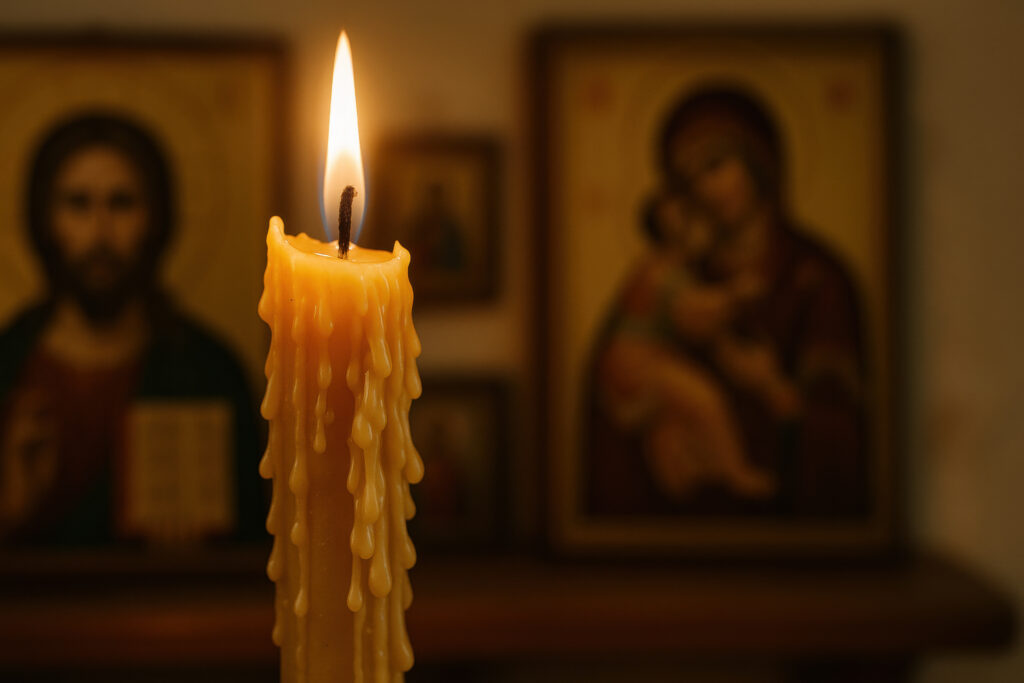
Spiritual
Conversion becomes possible when we practice renunciation, recollection, and prayer amid the noise of the digital city.
At the heart of Catholic.Work is Christ’s call: “Repent, and believe in the Gospel; for the kingdom of God is at hand.”
This is our way of life—turning continually toward God, renewing our minds in truth, and trusting His mercy. Repentance is not only sorrow for sin, but the daily re-orientation of our lives toward the transformative power of divine love and purpose.
Digital culture shapes our desires and rhythms, often pulling us away from interior freedom. We accompany men and women in learning to live a deep spiritual life without fleeing the digital world or surrendering to it. Through practices of discernment, prayer, and recollection, we help people recognize Christ walking with them even amid distraction—so technology serves conversion where possible, and never becomes a substitute for God.

Biblical
The Word of God in Sacred Scripture is primary in our commitment to build new roads to Emmaus in the digital city. Without it, we are ignorant of Christ (cf. St. Jerome).
In a world often reduced to the material and the self, Catholic.Work centers our labor, learning, and community in the living Word of God. “Man shall not live by bread alone, but by every word that proceeds from the mouth of God” (Matthew 4:4). Scripture is not merely text but encounter—Christ Himself speaking to His Body, the Church—shaping us through daily reading, Sunday reflection, and the prayerful rhythm of Lectio Divina.
In a digital culture saturated with information but hungry for meaning, we learn to listen reverently rather than scroll endlessly. We may use technology as a directional sign to that encounter, but we find that turning away from screens and digital realities is essential to reflective reading of the Bible. So we encourage in our work, leaving the mobile, the tablet, and the laptop aside, when possible, that the text of scripture may be felt, chewed upon, laid down, picked up, flipped through, and learned in context. Nothing replaces a physical text for man himself is both physical and spiritual.
This allows a more contemplative reading, less prone to distraction and disintegration… our hearts burn, eyes open, and the Lord is recognized along the road (cf. Luke 24). Thus, the Word dwells in us richly (Colossians 3:16).
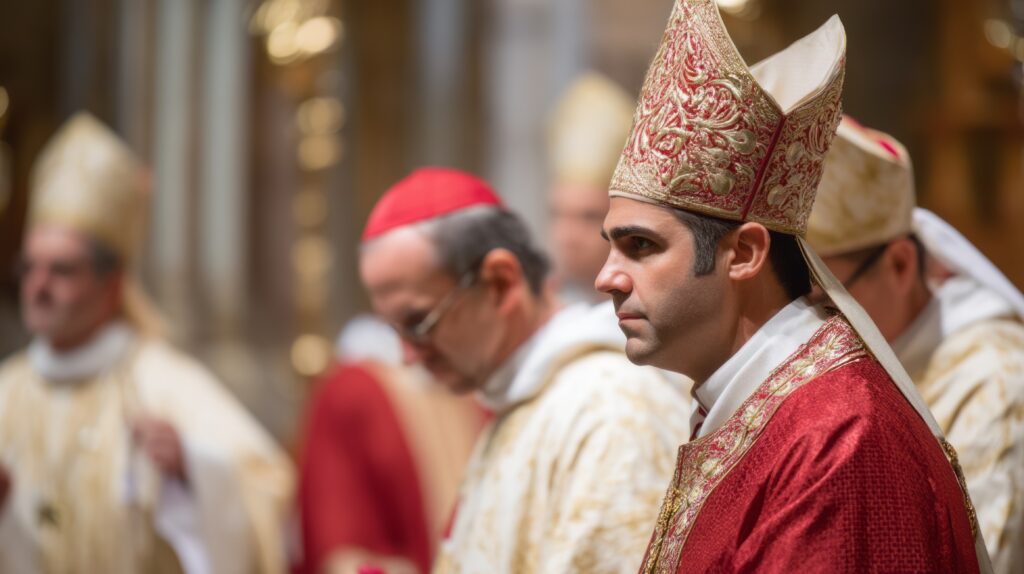
Sacramental
The Sacraments free us from control and self-curation by giving us objective grace and the real presence of Christ in our midst.
At the heart of the Church’s life are the Sacraments—visible signs entrusted to the Church through which Christ Himself acts and gives grace. In the Sacraments, we do not construct meaning or manage outcomes; we receive. They call us to holy poverty, setting aside the logic of technique, efficiency, and control so that we may be transformed by what we cannot produce. Objective and given, the Sacraments stand over against us, making true conversion possible.
In the digital city of customization and self-curation, the Sacraments bear quiet but radical witness: they truly communicate Jesus as Messiah and Lord, the Son of God and eternal Word of the Father—present and acting in His Body, the Church. We are on a path with others to rediscover sacramental life as an encounter rather than a performance, learning reverence, receptivity, and trust.
Having received what we did not create, we are sent into the world for mission.
Marian
Catholic.Work embraces a Catholic spirituality that, over the ages, in many different ways reflects upon Mary, Theotokos and Mother of the Church.
As followers of Jesus, who seek to incarnate Christ in union with the Holy Spirit, like our Blessed Mother, we rely on Marian practices, such as the Rosary, especially in the midst of family life.
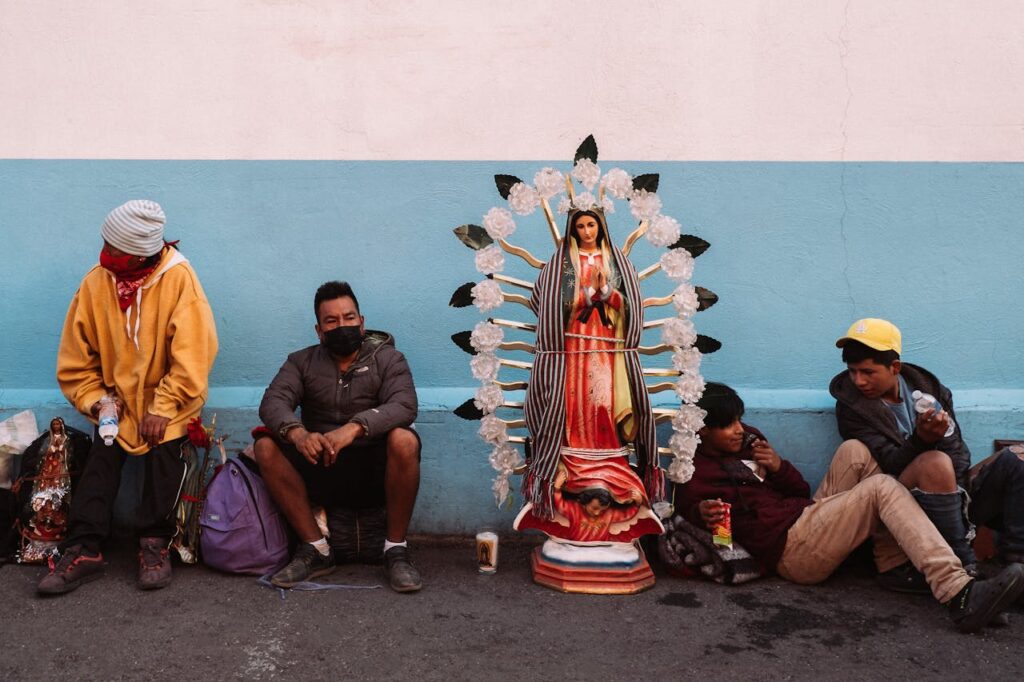
Shaped by the witness of the Blessed Virgin Mary as Mother, Disciple, and Evangelist. In a world called anew to encounter Christ, we look often invoke Mary under the title of Our Lady of Guadalupe, whom the Church venerates as the Star of the New Evangelization.
Through her, peoples came to meet the Lord, not by argument or power, but through humble presence, maternal love, and faithful witness. Mary shows us how evangelization begins: by receiving Christ first, bearing Him within, and offering Him to the world so that others may encounter Him as Savior and Lord.
Mary’s presence on Tepeyac reveals a way of mission especially needed in the digital city. She appeared not to the powerful, but to the poor; she bore Christ hidden within her; and she evangelized through beauty that spoke to the heart before the intellect—following her example, Catholic.Work seeks to accompany those experiencing every form of poverty—spiritual, relational, cultural, and technological—affirming their dignity and capacity for holiness.
We reject both domination and withdrawal, learning instead a Marian way of mission: receptive rather than controlling, contemplative rather than reactive, faithful rather than performative. With Mary, we seek to recognize Christ already present and at work, and to help others encounter Him amid the complexity and fragmentation of modern life.
What can I do to participate in the mission of Catholic.Work?
There isn’t a limit to how someone, or a family, or a community, may support or join in mission with Catholic.Work. Some may find our resources beneficial and want to use them. Others may wish to contribute to the mission. How might you contribute to our mission? Take that to prayer.
We are especially interested in attracting those directly involved in technology work, such as programmers, developers, DevOps, vibe coders, AI enthusiasts, IT staff and directors, web designers and developers, and software engineers. In these areas, we currently have several specific projects that need additional support to launch.
But also, perhaps you are a writer, a teacher, an artist, a business executive, maybe you are on disability, or perhaps you are in college and still deciding about what lies ahead. Reach out to us and ask how you can help.
We are currently developing our Board and need various experts to guide the non-profit dimension of our work.
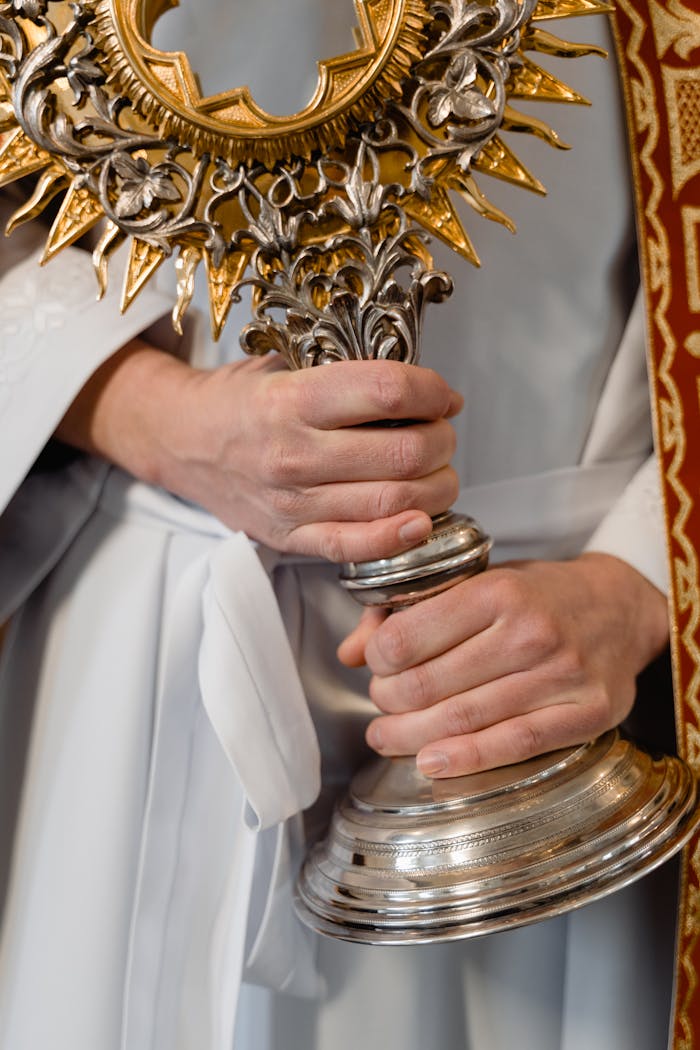
The Holy Eucharist
The Eucharist is the heart of Catholic.Work—the living center where Word, family, and fellowship are gathered into the one Body of Christ. “The bread that I will give for the life of the world is my flesh” (John 6:51). In this mystery, repentance becomes offering, labor becomes worship, and communion becomes mission. As we receive Christ, we are sent to live Eucharistically: to make of our work, our homes, and our lives a continual act of thanksgiving to God.
Sacred Liturgy
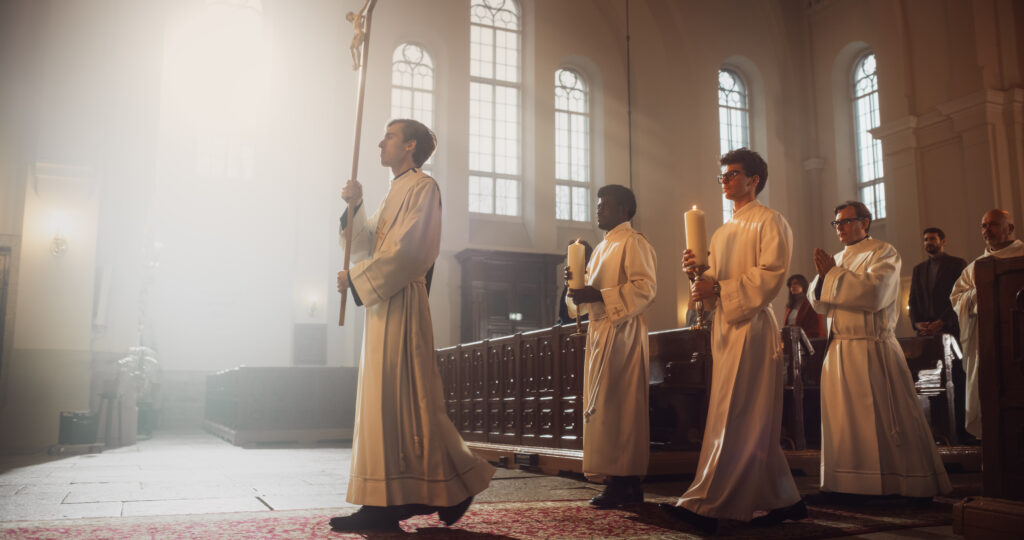
“You shall love the Lord your God with all your heart, and with all your soul, and with all your might” (Deut 6:5). Catholic.Work is ordered around this first and greatest commandment, lived through the Sacred Liturgy—the Church’s continual worship of the Triune God. The Holy Mass is the source and summit of all we do; from it, the Liturgy of the Hours carries praise into the rhythm of daily life, sanctifying our work and time. In adoration and thanksgiving, worship becomes the pattern of every act of love and labor. We have experienced that returning to the heart of the first commandment is the most direct way to encounter Jesus on new roads to Emmaus.
Join Us Today
Christ still walks the road with His disciples. “Did not our hearts burn within us while He talked to us on the way?” (Luke 24:32)
Come walk with us as we build new roads to Emmaus in the digital city.